Comedy 2010s R 99 min
The Grand Budapest Hotel (2014) review
A legendary concierge and his lobby boy navigate a stolen painting, a family fortune, and the collapse of Europe. Anderson's funniest and saddest film.
Wes Anderson's films are usually described as dollhouses. The Grand Budapest Hotel is a dollhouse with a war approaching it from off-screen, and the film's considerable achievement is that it is simultaneously his funniest and his most genuinely mournful.
The Nested Structure
The film is told in four nested frames: a young woman reading a book at a memorial, the author narrating in 1985, the author as a young man in 1968 meeting the hotel's owner, and Zero's account of 1932. Each frame has a different aspect ratio, a different colour palette, and a different camera language. This is not decoration; the framing device establishes that everything we see is a memory of a memory, and that the world it depicts is already gone.
Anderson uses the nesting to make a specific argument about nostalgia. The 1932 sections are the most vivid and the most colourful, and they are the ones furthest removed from the present. The film's celebration of a vanished world is inseparable from its awareness that the world vanished for a reason, and the final frame's return to the 1985 present is quietly devastating.
Read more about comedy cinema in our Comedy genre hub, explore the work of Wes Anderson in our directors section, or see where this film lands in best films of the 2010s.
Fiennes and the Comedy of Competence
Ralph Fiennes gives the best performance of his career as M. Gustave, and the performance is the film's engine. Gustave is a man whose entire identity is service — he knows every guest, he recites poetry at dinner, he sleeps with elderly women as a professional courtesy — and Fiennes plays him with total conviction and no wink. The film's funniest moments are all Gustave being extremely good at something trivial.
The comedy is built on competence rather than incompetence, which is unusual. Gustave is not a fool; he is a professional in a world that is about to stop valuing professionalism. His profanity, delivered with perfect diction, is one of the great comic inventions in recent cinema, and the running gag of his cologne and his 'lobby boy' instructions never wears thin.
Anderson's Formal Apparatus
The film is Anderson's most technically elaborate, and the craft is genuinely astonishing. Adam Stockhausen's production design includes a full-scale model of the hotel built at multiple scales, and the film's miniature work is deliberately visible — a choice that makes the world feel constructed and therefore fragile. Alexandre Desplat's score uses balalaika and alpine instrumentation, and it is his best work with Anderson.
The symmetry and the whip-pans are present, but the film's formalism is more purposeful than Anderson's detractors allow. The chase sequences are staged with a clockwork precision that is funny in itself, and the film's violence — severed fingers, a cat thrown out of a window, a shootout in a museum — is presented in the same stylised register, which creates a genuine tonal unease beneath the pastel surface.
The Melancholy
The film is explicitly about the rise of fascism in 1930s Europe. The 'ZZ' insignia, the border checkpoints, the soldiers at the hotel — all of it is presented as a background hum that gradually becomes the foreground. The film's famous line about the world being 'mostly grey' arrives in a film that is otherwise saturated with colour, and the contrast is the point.
The ending is far bleaker than the film's reputation suggests. Zero loses everyone he loves, the hotel declines, and the 1968 frame shows a man who has spent decades maintaining a building as a monument to a dead woman. Anderson has never been this emotionally direct, and the fact that he achieved it inside a film this funny is the strongest argument for his seriousness as a filmmaker.
Verdict
Anderson's best film and the clearest demonstration that his formalism is not an evasion but a delivery system. Fiennes gives a career-best performance, the nested structure is genuinely meaningful rather than merely clever, and the film's final movement into melancholy is earned by everything before it. It is funny throughout and sad by the end, which is a difficult combination that very few directors attempt.
What works
- Fiennes' Gustave is a comic creation of real depth
- Nested frames do thematic work rather than decorative work
- Manages genuine melancholy inside a comedy
What doesn’t
- Anderson's style is an acquired taste and this is his most stylised film
- The violence sits uneasily with the tone for some viewers
Themes and ideas
- Nostalgia and its limits
- The collapse of civilised Europe
- Professionalism as identity
- Memory and reconstruction
Frequently asked questions
What are the different aspect ratios for?
Each time period has its own ratio: 1.37:1 for the 1930s sections, 1.85:1 for 1968, and 2.35:1 for 1985 and the framing sequences. This makes each era visually distinct and reinforces the sense of nested memories.
Is the hotel real?
The exterior is a combination of a real building in Görlitz, Germany, and detailed miniatures and matte paintings. The interior sets were built at Babelsberg Studios.
What is the film's connection to Stefan Zweig?
Anderson has said the film was inspired by the writings of Austrian writer Stefan Zweig, particularly his memoir The World of Yesterday. The character of Gustave is partly modelled on Zweig's descriptions of pre-war Viennese courtesy.
Does the film have a happy ending?
No. The 1932 story ends with Gustave's death, and the framing narrative reveals that Zero's wife and the hotel itself are gone. The film's final image is of a man maintaining a monument.
More comedy films we have reviewed
Every review is scored and argued. These are the closest films in our collection to The Grand Budapest Hotel.
-
 97
97
Spirited Away review
A sulky ten-year-old wanders into a world of spirits, loses her name, and has to work for a living. Miyazaki's most complete film and his most quietly…
★★★★★ 5.0/5
-
 89
89
La La Land review
A jazz pianist and an aspiring actress fall in love in Los Angeles, and the film builds to a finale that has divided audiences since release.
★★★★½ 4.6/5
-
 92
92
Everything Everywhere All at Once review
A laundromat owner discovers she must connect with parallel versions of herself to save existence, and the film turns out to be about a mother and a d…
★★★★½ 4.7/5
-
 92
92
Interstellar review
An unusually earnest science-fiction film that treats relativity as a source of grief. When it works it is overwhelming; when it explains itself it st…
★★★★½ 4.7/5
-
 96
96
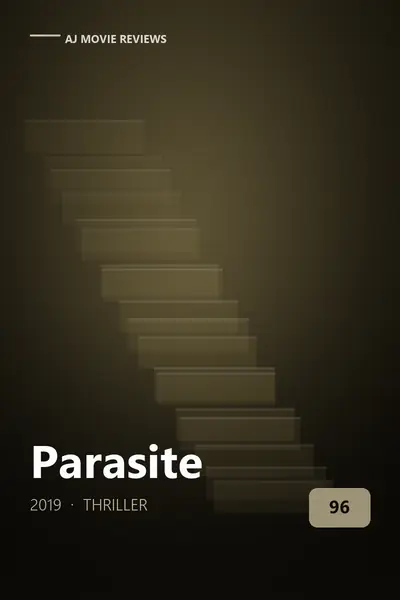
Parasite review
A poor family infiltrates a rich household, and the film turns into something else entirely. The staircase motif is not decoration — it is the thesis.
★★★★★ 5.0/5
-
 95
95
The Lord of the Rings: The Fellowship of the Ring review
The first and best of the trilogy, and the film that proved a sincere fantasy adaptation could be a serious piece of filmmaking rather than a novelty.
★★★★½ 4.9/5
About the reviewer
A. J. Whitlock founded AJ Movie Reviews after a decade of writing about film for regional publications and a film society newsletter that nobody else wanted to run. He holds a degree in Film Studies and has worked as a projectionist, a cinema duty manager, and a very bad film festival volu…
A note on this review
This review is based on a full viewing of the film and contains no spoilers beyond what the marketing material reveals. We do not accept payment, gifts, or press trips in exchange for coverage.